Local taxes
Indirect taxes and the main direct taxes – the tax corporate and the personal income tax – are paid into the central budget. Both entrepreneurs and consumers pay direct taxes into local municipal budgets. They form part of the revenues in local budgets, and the other part is a transfer from the central budget. Local taxes implement the so-called fiscal decentralisation . The larger the share of revenues from them, the more financially independent the municipality is.
Local taxes are regulated in the Local Taxes and Fees Act. However, fees are not taxes and are different in nature, which is why they are discussed separately (for more information see article ‘ Other payments to the state ’). The tax rates of local taxes are set annually by municipal councils. However, the range in which they can vary is determined by establishing a lower and upper limit at a national level.
The collection of local taxes is carried out through the local municipal administration. They can be paid in cash - at the administration's cash desks, or to the municipal bank account. Many payment service providers such as banks and payment institutions automatically extract the obligations and offer the possibility of their quick and easy payment.
Immovable Property Tax
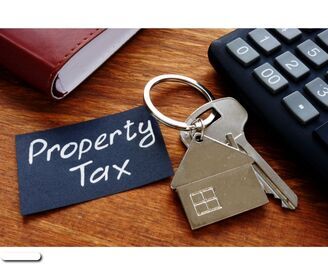
The immovable property tax is a direct property tax. It does not matter whether the property is used or not. The decisive factor for the taxation of entities is the existence of ownership, the establishment of a real right of use, or the concession of the property. Unlike the direct taxes considered, the immovable property Tax is paid in the year in which it is due. The tax is paid in two instalments – by June 30 th and by October 31 st . A 5-percent discount is applied to those who pay by April 30 th .
Immovable property Tax is owed by owners and co-owners of buildings and independent objects in them, as well as regulated land properties outside populated areas in Bulgaria. Each of the co-owners owes a tax proportional to their ideal parts. Agricultural land and forests are not taxed, with the exception of any built-up area and its adjacent terrain. Some properties with a tax assessment below a certain range, which is defined in the Local Taxes and Fees Act, are also exempt. There are also a number of other properties that are exempt from tax – for achieved energy efficiency, cultural monuments, galleries, etc. For an up-to-date list of properties exempt from tax, it is advisable to consult the relevant legislation.
The amount of the tax liability depends on the tax base and the tax rate. The base is the tax assessment of the property, which is determined in accordance with the Local Taxes and Fees Act, and for non-residential properties owned by enterprises – the book value. The tax rate ranges from 0.1 to 4.5 per thousand.
A tax relief for a primary residence is also provided. It applies to a property that serves the housing needs of a person for the predominant part of the year. The relief is used only for one property, and it is necessary to declare which one it is. Even if a person owns only one property, it is necessary to declare it as a primary residence in order to benefit from the relief. The reduction is 50 per cent. If the person has a reduced working capacity of more than 50 per cent, the reduction is 75 per cent.
Vehicle Tax
The vehicle tax is a direct property tax. It does not matter whether the vehicle is used or not. For taxation, it is sufficient that the vehicle is registered. The tax is paid in the year for which it is due, in two instalments - by June 30 th and by October 31 st . A 5 per cent discount is applied to those who pay by April 30 th .
A wide range of vehicles are taxed - land, water and air. These include: cars and trucks, tow trucks, buses, motorcycles, truck cranes, tractors, jets, yachts, scooters, balloons and gliders, etc.
The tax depends on the type of vehicle. In the most general case – for cars and trucks, there are two components – property and environmental. The property component takes into account the engine power and year of manufacture of the vehicle. The environmental component depends on the environmental category.
A number of vehicles are exempt from taxation. For an up-to-date list, it is advisable to consult the relevant legislation. The most important of them are: deregistered vehicles, electric cars(except hybrid ones) and other electric vehicles, passenger cars of persons with reduced working capacity of over 50 per cent (under certain requirements), etc. Tax relief is provided for some buses, mopeds and motorcycles.
Tax on Property Acquisition for Consideration
In addition to owning a immovable property and a vehicle, the Local Taxes and Fees Act also stipulates the tax on property acquisition for consideration. The tax is due upon the notarial transfer of ownership. It is paid by the notary. Please note that not the entire amount you pay to the notary is their fee. When planning to purchase a vehicle or real estate, be sure to calculate in advance how much the transfer of ownership will cost – this is the sales price together with notary fees and the tax due.
In the case of a property acquisition for consideration, the tax rate is from 0.1 to 3 per cent of the property valuation at the time of transfer. For real estate, the tax base is the agreed price, and for vehicles – the tax base is the insurance value.
Donation Tax
Both the property acquisition for consideration and the gratuitous acquisition of property are subject to tax. The donation tax is levied on the recipients of property, except when they are spouses and direct relatives. Depending on the type of property, a different tax assessment is determined. For real estate, this is the tax assessment, for foreign currency and precious metals – according to the foreign exchange rates of the Bulgarian National Bank, for vehicles - on the insurance value, and for securities – according to their market value.
The tax rate is also defined by the Local Taxes and Fees Act. It varies and depends on the relationship between the persons. In case of a donation between siblings, it is from 0.4 to 0.8 per cent. In case of other persons – from 3.3 to 6.6 per cent.
Inheritance Tax
Inherited property is subject to inheritance tax , defined by the Local Taxes and Fees Act. The tax liability applies to heirs by law or will and legatees (who receive a specific single property). It should be borne in mind that inherited property includes not only property, but also other rights, receivables, as well as obligations.
The tax base is determined more complicatedly, as it differs depending on the nature of the inheritance. For example, immovable properties taxed according to their tax assessment, vehicles – according to their insurance value, currency and precious metals – according to the Bulgarian National Bank exchange rate, etc. The provisions of the Inheritance Act are also applied, forming inheritance shares.
The tax rate also differs depending on the relationship that the heirs had. Spouses and direct heirs do not pay tax. The tax that siblings and their children and all other heirs pay is determined depending on their inheritance share. Certain assets are exempt from taxation – household goods, unreceived pensions, libraries and musical instruments, small agricultural equipment, etc.
When calculating the tax due, the testator's obligations, funeral expenses up to a certain limit, determined in the Local Taxes and Fees Act, as well as property that has already been inherited by the testator in the last 3 years, are also deducted.
Other Local Taxes
There are other local taxes that are more specific. For example, the patent tax . It is due by individuals and sole traders who have a small business or are craftsmen carrying out certain activities: trade in an area of up to 100 sq. m., accommodation with no more than 20 rooms, restaurants, craft services (carpentry, tailoring, shoemaking, hairdressing, typing, cosmetics, watchmaking, upholstery, car repair, glass), games of an entertaining or attractive nature, paid parking lots, driver training, sales of newspapers and magazines, pawnshops, etc.
The Local Taxes and Fees Act also determines the tourist tax, which is due for overnight stays in hotels and guest houses. Its amount is determined by the respective municipal council and varies depending on the settlements within the municipality and the category or registration of the accommodation places according to the Tourism Act. It is paid by the overnight guest but is paid to the local council by the owner of the accommodation.
A local tax is also imposed on taxi passenger transport . Its amount is determined by the municipal council within the limits set by the Local Taxes and Fees Act. The tax is payable only by carriers who hold a registration certificate issued by the Executive Director of the Automobile Administration Executive Agency, and a permit for taxi passenger transport issued by the mayor of the respective municipality. To determine the tax, the taxable person submits a declaration to the municipality using a standard form.
If necessary, check the relevance of the amount of taxes in the relevant regulatory documents.
Useful links:
Tax on Onerous Acquisition of Property
 This article has been prepared with the support of the OECD, as part of the project "Strengthening the Capacity for Implementation of the National Financial Literacy Strategy", funded by the EU through the Technical Support Instrument. This material is for informational and educational purpose only. It does not constitute investment advice, a recommendation or offer to buy or sell financial instruments, or the provision of any other type of investment services. More information can be found here.
Useful instruments
Glossary
Partners